If marketers want to adopt the 4Ps, rather than just the single ‘P’ of Promotion, they need skin in the game.
But a significant tension exists here. If a marketing lead has historically been viewed only as the steward of Promotion, stepping into the other 3Ps requires a delicate re-negotiation of their role. Using a retail bank as an example, this involves an iterative approach - a process that demands time, trust, and a state of equilibrium with the CFO, CEO, and CIO.
For many, the sheer scope of the 4Ps feels overwhelming. It is easier to retreat into the familiar territory of the 1P (Promotion), which is a surefire way of focusing on performance over brand. Even worse than the 1P.
CMOs need to face the structural friction of the other three.
However, a business is an interconnected system. Growth is its natural state, yet it is often halted by specific Limiting Factors- bottlenecks in the infrastructure, pricing, or product feedback loops. The eOS (Effectiveness Operating System) uses a RACI-driven governance model to identify and unlock these factors, ensuring Marketing functions as a primary driver of enterprise value.
The Psychology of the Boardroom
Charlie Munger’s The Psychology of Human Misjudgment identifies the cognitive traps that cause even the smartest executives to make disastrous decisions. When we apply these to a bank’s governance, we see exactly where the leaks in the growth engine occur.
**Step 1: The RACI **
Using a retail bank as a use case for my thinking.
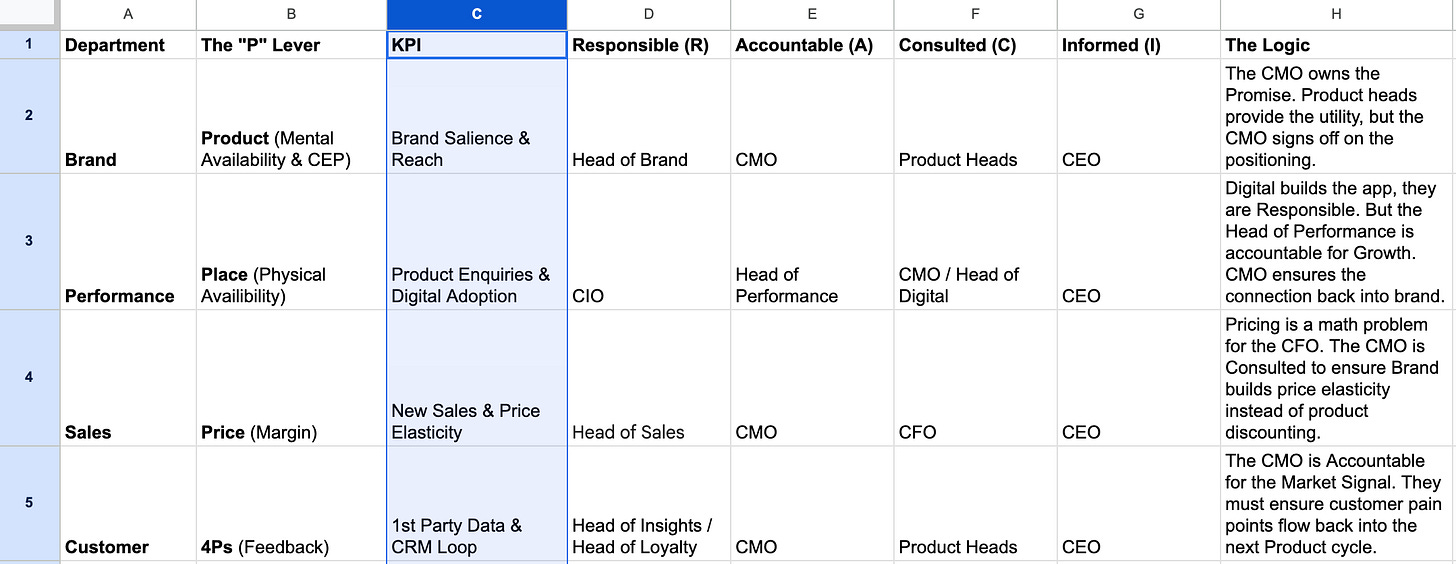
Retail Bank example
1. Product: Leveraging the Category Entry Point
In banking, the Product isn’t a physical object. It’s rather a mental shortcut for a life stage (e.g., My First Home). If the CMO doesn’t own the Accountability for this positioning, the bank defaults to generic utility.
Unlocking this means moving away from Product Heads deciding what to build in a vacuum and instead letting the Market Orientation dictate the strategy and roadmap - therefore driving the KPIs.
Not the other way around.
2. Place: Creating the Digital Platform
In a digital-first bank, the App represents the Place (Physical Availability). If the App experience is cumbersome, every dollar spent on media is effectively taxed by technical friction. This is a classic Limiting Factor.
By assigning the CIO Responsibility for Digital Adoption, we align the technology roadmap with the brand’s commercial goals. This counteracts the “Man-with-a-Hammer” tendency, where IT focuses solely on server uptime while Marketing focuses solely on ads. In this framework, the technology is measured by its ability to facilitate the customer’s journey, transforming the tech pipeline from a bottleneck into a growth lever.
3. Price: Protecting the Margin
The tension between Volume and Margin is where most growth becomes unhealthy. Driven by Incentive-Caused Bias, sales teams often default to discounting to hit quarterly targets. This creates a “Lollapalooza Effect” - a convergence of biased decisions are made and so a downward spiral where competitors are discounting and the fear of losing market share destroy long-term profitability.
The eOS addresses this by making the CFO** Accountable for New Sales & Price Elasticity.**
When Finance owns Elasticity (IMPORTANT), the conversation shifts.
Instead of viewing Marketing as an expense to be cut, the CFO views it as the engine that creates Price Premium. If the brand positioning is strong, the bank can acquire customers without eroding its interest margins. Marketing provides the value signal that justifies the price the CFO is tasked with protecting.
4. The Feedback Loop
The final Limiting Factor is often Institutional Blindness. The bank keeps making the same product mistakes because the customer signal never makes it back to the strategy.
The CMO’s true leverage lies in being the bookend of the business. By owning both the Diagnosis (Brand Positioning) and the Feedback (Data Loop), the CMO ensures the bank remains Market Oriented. This data loop serves as the system’s sensor, tracking whether the Brand Promise is being fulfilled by the Product and the Price. It turns the bank into a learning organism that self-corrects for growth.
Step 2: The Sensors to steer Traction
A CMO transitioning to a 4P model should not be an act of individual willpower relying him/her being a champion; it should rather be an act of structural design.
The RACI model is, at its core, a Growth Diagnostic. It identifies which executive owns which valve in the growth engine. If the brand isn’t growing, the RACI tells you exactly who is involved in fixing it.
By documenting these roles, we create a shared language for the C-Suite. We define the KPIs that drive growth and the Counter-Metrics that signal systemic failure. This clarity allows a Head of Marketing to step out of the promotion silo and into a role that contributes to the fundamental architecture of the bank.
Fixing this incrementally is difficult, but it is the only way to build a business that is rational, resilient, and remarkably effective.