Smart marketers often do things that don’t make sense.
They optimise for last-click attribution and call it “ROI.” They over-invest in performance marketing at the expense of long-term brand equity. They participate in what WARC calls the Doom Loop of declining effectiveness.
They don’t do this because they lack the data or the intellect. This is a survival tactic.
To understand why marketing effectiveness is in a state of inertia, I’ve been looking at Game Theory to bring clarity to my thinking.
The Equilibrium of the Boardroom
In marketing, we are stuck in a classic coordination problem— this is our equilibrium, which most have aligned to.
The CFO is coordinated on ROI.
The Procurement team is coordinated on ROI.
Therefore the Agency is coordinated on ROI.
The Ad Platforms know this, so they are built to maximise ROI.
To remain compatible with the organisation, the CMO has no choice but to speak the same language.
If a CMO tries to switch to a better, more holistic system in isolation— like reporting on Distinctiveness— they hit a Glass Wall. When the rest of the industry is reporting a “5x ROI” and the CMO is talking about “Long-term Signals” the CMO looks like they are failing.
In a vacuum, innovation is difficult; it’s a career-ending move. This tension creates a state of paralysis where everyone knows the system is flawed, but no one can afford to be the first to stop.
You Cannot Strong-arm Your Way Out
The biggest mistake I see is the attempt to fix this from the bottom up. You cannot drop a new dashboard in front of a CFO and expect them to “trust the vibes” of a new metric.
You have to orchestrate a smooth transition to a new system**.** This takes time—usually 6 to 12 months—and it depends entirely on the maturity of the relationship between the CMO and the CFO.
Here are my two-steps for changing the game.
Step 1: The Bridge (Staying in Equilibrium)
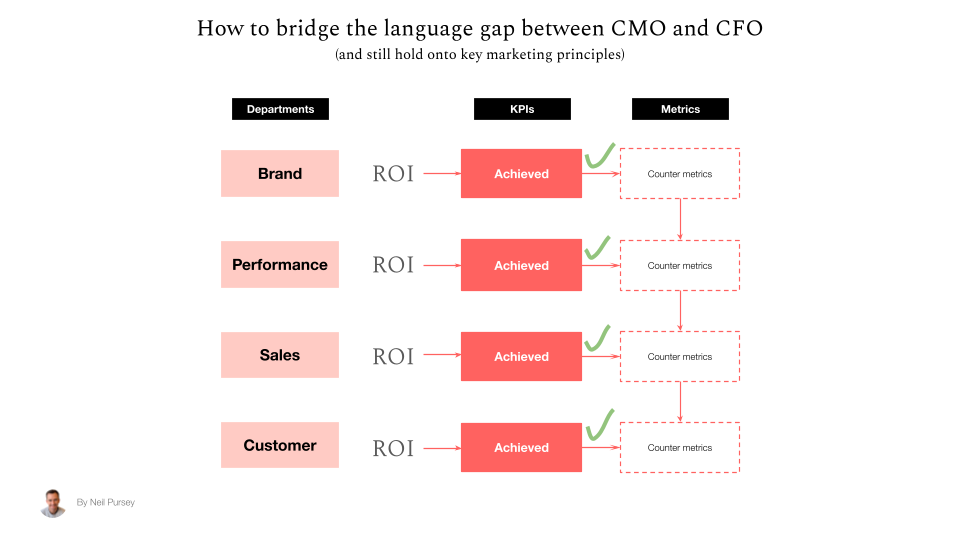
The first rule of the bridge is: The language of ROI stays. We keep ROI as the primary signal for the CFO because it provides the psychological safety the boardroom requires. However, the CMO begins to position it differently. We align ROI to the specific Departmental Business Challenge.
I have changed my views on silos. They aren’t inherently bad; in fact, specialisation is where judgment lives. The key is to break the glass walls between them while keeping the specialists focused.
In this new alignment:
- The Brand team has a specific ROI.
- The Performance team has a specific ROI.
- The Sales team has a specific ROI.
- The Customer team has a specific ROI.
If each department answers its original business challenge and hits its functional KPIs, that is a form of ROI. By framing it this way, the CMO stays in equilibrium with the Board, but the system begins to pivot toward actual effectiveness.
Step 2: The Guardrails
Behind every ROI figure, the CMO must identify counter-metrics. These are the filters of truth. I like to call them the metrics that keep the KPIs honest.
These counter-metrics address the quality and effectiveness of the KPI. They ensure the team doesn’t drift into short-term performance only mindset just to satisfy a monthly report.
Once this governance is established, and the CFO begins to understand the lag impact of marketing on sales, the trust is built to move into the gold standard: Incrementality and Marketing Mix Modeling (MMM).
A Note on Maturity and Building the Scaffolding
A lot of brands rush into MMM because they think it’s a magic bullet for the ROI problem.
It isn’t. MMM will fail if the system has no governance. If you don’t have the scaffolding across Insights, Strategy, Creative, and Media, you are feeding sophisticated math into a broken engine.
You need the guardrails of the Effectiveness Operating System (eOS) before you can defend the model.
My Verdict
The reason your marketing feels stuck is not because of a lack of willingness to fix or lack of talent; there’s an inability to change the equilibrium between the CMO and the CFO. Understanding the the psychology of it has been a game changer for my clients.
I build these measurement frameworks to provide the bridge that satisfies the CFO and the governance that protects the CMO from drift.