In Good Strategy/Bad Strategy, Richard Rumelt defines the kernel of a strategy as three distinct elements: a diagnosis of the challenge, a guiding policy to deal with that challenge, and a set of coherent actions.
In modern marketing operations, the diagnosis is frequently missing. Instead, organisations skip directly to setting KPIs, which are then treated as the strategy itself. When a KPI becomes the strategy, the process becomes reactive. Teams optimise for a metric, such as ROAS or Brand Awareness, without understanding if that metric actually addresses the underlying business friction. This approach is a hallmark of Bad Strategy.
The Internal Nature of the Business Challenge
Most marketing challenges are internal. They often stem from distribution bottlenecks, price-elasticity issues, or a lack of organisational clarity regarding the value proposition.
When a business understands its specific internal obstacles, it shows up in the job specifications and the KPIs. Conversely, generic marketing KPIs, the kind found in most job descriptions - signal that the business has not yet diagnosed its actual challenge. If a company faces a physical availability problem, a high-reach Brand KPI is a misallocated resource. You can see the health of a strategy by how bespoke its metrics are to the internal diagnosis.
The Effectiveness Operating System: A Grid of Coherence
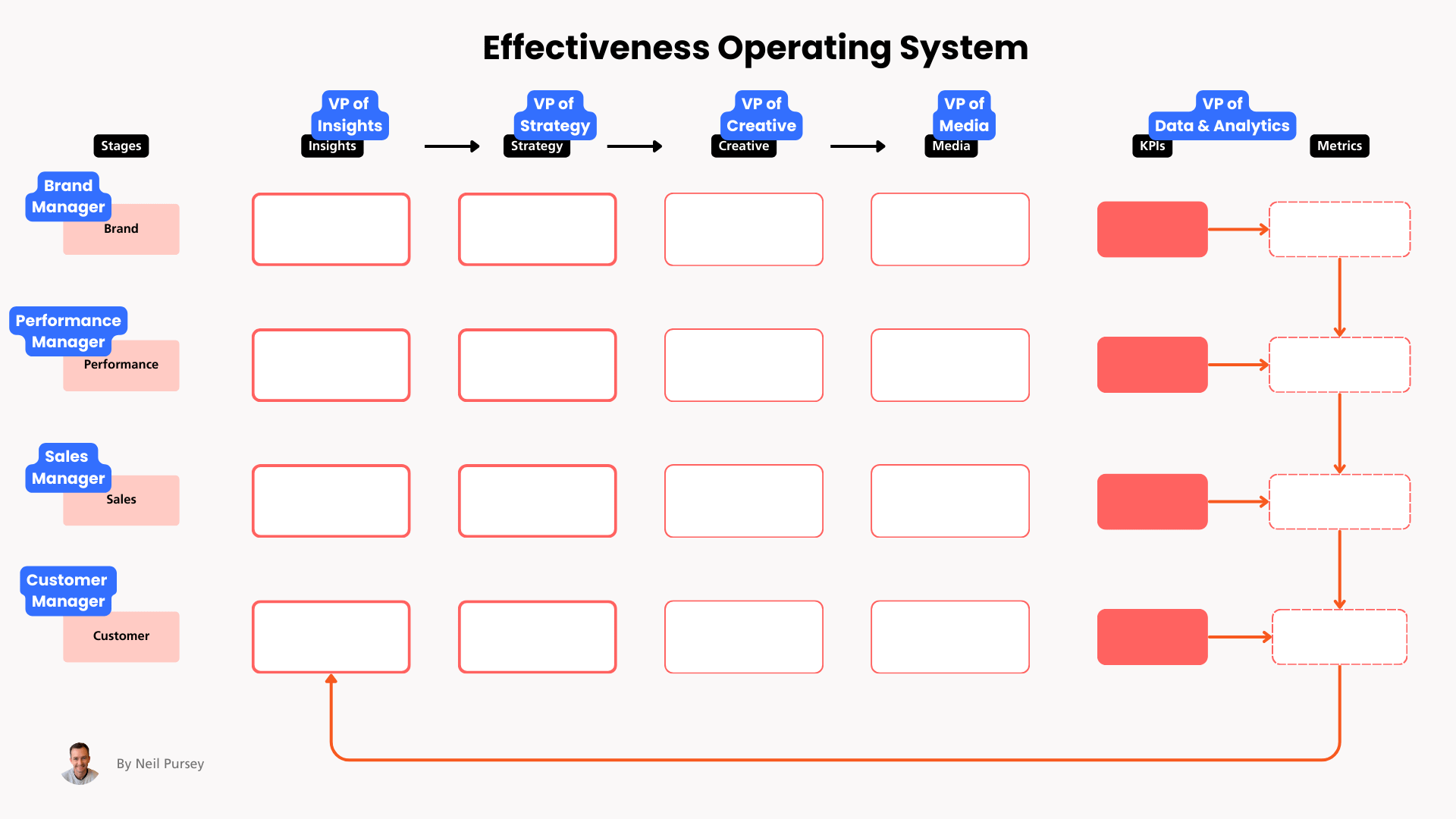
The Effectiveness Operating System (illustrated below) provides a framework for coordinating effort across a marketing department. For this system to function, the internal team must lead the first two pillars: Insights and Strategy.
Horizontal Strategic Flow
The horizontal movement from Insights to Media represents the transition from thought to action.
- The Internal Responsibility: The VP of Insights and the VP of Strategy own the diagnosis and the Guiding Policy. This policy is the brief.
- The Agency Execution: The VP of Creative and the VP of Media execute the Coherent Action.
The breakdown usually occurs at the brief. When internal teams fail to diagnose the challenge, they pass ambiguity to their agencies. An agency cannot execute effectively if the Guiding Policy is absent or contradictory.
Vertical Alignment: Breaking the Silos
The vertical rows: Brand, Performance, Sales, and Customer; test the coherence of the organisation. In an ineffective system, these managers operate as independent silos, each solving for a different perceived problem.
Coherence requires that the Brand Manager and the Sales Manager work from the same diagnosis. While their tactics differ, their actions must be coordinated toward the same central obstacle. If the Insights pillar does not serve as a single source of truth, the vertical arrows in the KPI and Metrics columns will provide noise rather than a clear picture of business health.
The Role of the Agency in Building Capability
When internal strategy is poor, the agency has an opportunity to lead by building client capability. This is particularly critical in environments where measurement systems are immature. A lack of mature measurement creates a cycle of negative KPIs, where teams optimise for short-term incentives rather than long-term business health.
Agencies that succeed in this environment move beyond media execution to focus on three areas:
- Measurement: Implementing systems that move beyond vanity metrics to show how marketing effort affects the diagnosed business challenge.
- Incentive Alignment: Understanding the psychology of human incentives, specifically the client’s internal KPIs; and helping them align those incentives with actual business growth.
- Creative Governance: Ensuring that creative and media principles are upheld over the long term, allowing campaigns the time to wear-in and generate cumulative effects.
Practical Solutions for Strategic Coherence
To move toward a more effective operating system, marketing leaders can implement these diagnostic steps:
- Lead with a Diagnosis: Before setting a KPI, write a one-paragraph diagnosis of the specific business challenge. If you cannot identify the obstacle, you cannot form a strategy.
- Audit the KPIs for Genericism: If your KPIs look identical to those of your competitors, they are likely disconnected from your specific business challenge. Real strategic KPIs are bespoke to the diagnosis.
- Define the Strategy in the Brief: Use the brief as a document of Guiding Policy. It must explicitly state how the proposed creative or media work addresses the internal challenge identified in the diagnosis.
- Enforce Vertical Communication: Ensure that the VP of Data & Analytics is reporting on metrics that ladder up to a unified picture of success across Brand, Performance, Sales, and Customer roles.
When the internal team owns the diagnosis and the agency executes a coherent policy, the Effectiveness Operating System functions as a competitive advantage rather than just a visual framework. Coherence in strategy is rare; when it is achieved, it creates a significant gap between an organisation and its competitors.