My fear. When marketing effectiveness collapses because the boardroom and the execution team share the same metrics. Marketing measurement is often pigeon-holed to a handful of outcome focused metrics that all of marketing shares. The fundamental challenge is a flawed thinking of marketing principles. And it seeps through into the C-Suite.
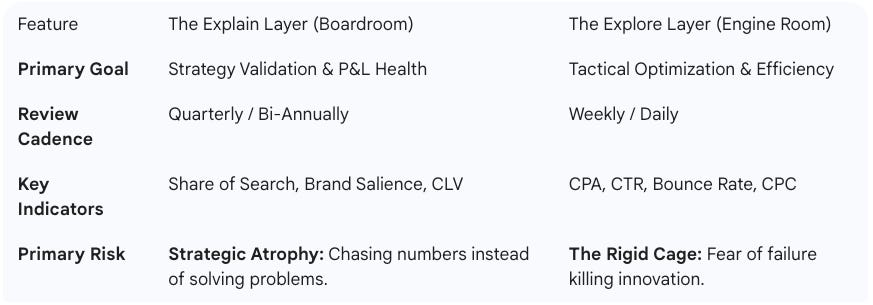
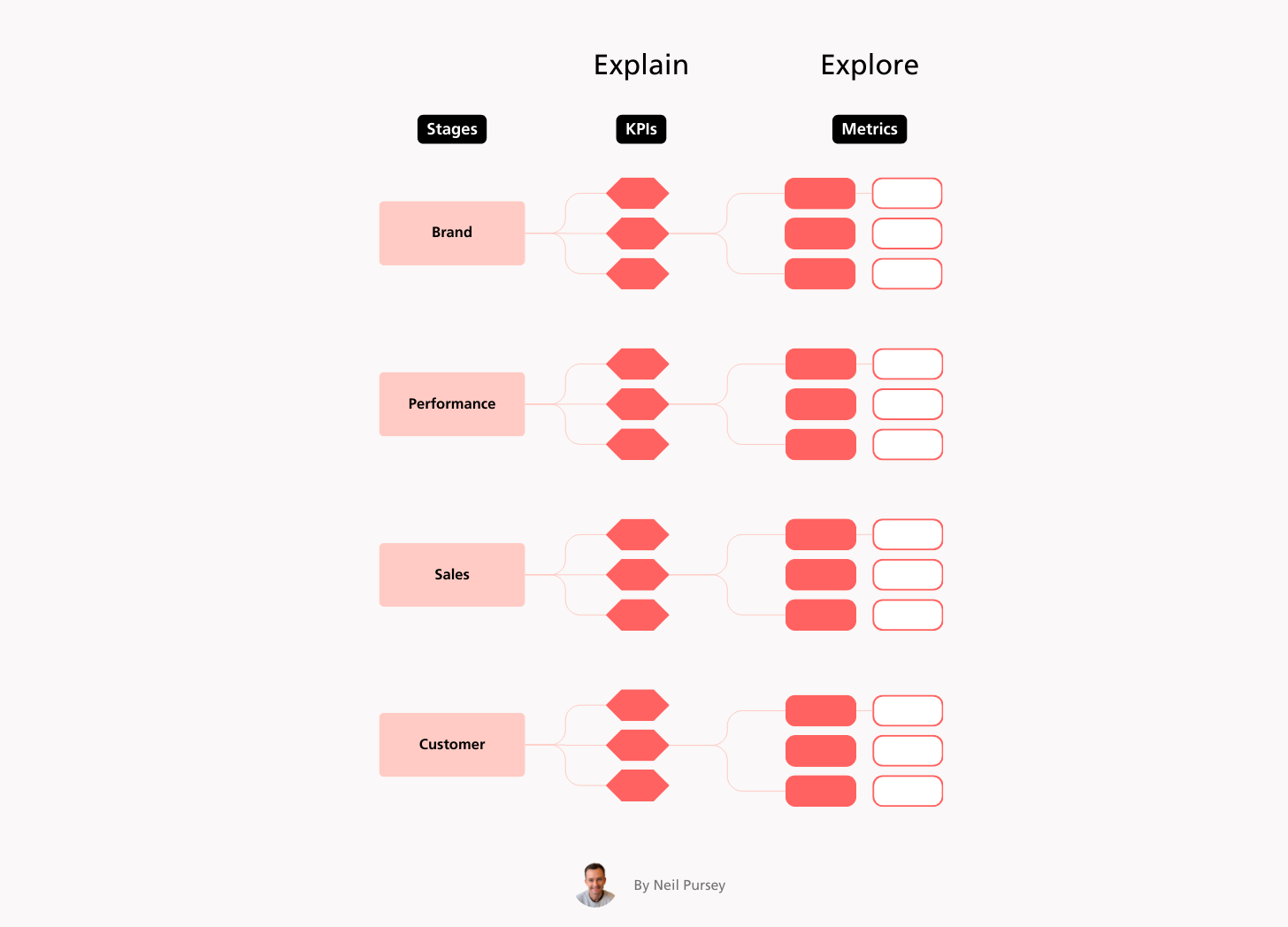
For marketing to maintain strategic clarity, an organisation must operate with a structural separation of data: the Explain Layer and the Explore Layer 1.
Without these guideposts, leadership defaults to micro-management, and execution teams default to playing it safe. Clarity in measurement should be the prerequisite for growth. Therefore marketing measurement needs a clear understanding of what the actual business challenge is.
The Explain Layer: Long-Term Governance
The Explain Layer belongs to senior management and the board. These metrics are backward-looking, slow-moving, and tied directly to the P&L. They exist to justify the budget and validate the long-term health of the business.
Key indicators in this layer include Brand Salience, Customer Lifetime Value (CLV), and Share of Search (SoS). Share of Search, in particular, acts as a predictive bridge. A signal of future market share. When your Share of Search outpaces your Market Share, growth is the mathematical inevitability. This is the North Star that prevents a C-Suite from overreacting to a bad week of sales.
The Explore Layer: The Engine Room
The Explore Layer is the domain of execution. These metrics are granular and fast-moving, used on a weekly or daily basis to identify marginal gains. Specialists focus on click-through rates, cost-per-acquisition, and landing page performance.
The function of this layer is to identify what to optimise next. However, these metrics often become a Micro-Metric Trap. Tactical data provides instant feedback, which creates an illusion of control. Also, highly addictive. In a high-pressure environment, a green arrow on a low weighted metric feels like progress, even if it is entirely decoupled from the brand’s long-term trajectory.
The High Cost of Tactical Obsession
Organisations that prioritise the Explore layer at the expense of the Explain layer eventually suffer from strategic atrophy. This is a functional decline where leadership loses the capacity to diagnose business problems because they are preoccupied with platform fluctuations.
The Performance Plateau
Efficiency has a natural ceiling. A marketing department focused exclusively on tactical optimisation will eventually hit a Performance Plateau or as WARC has coined, “The Doom Loop”. This occurs when you have refined every keyword and A/B tested every landing page, yet growth remains stagnant.
Tactical optimisation to the point of saturation is the process of capturing existing demand - those who would’ve bought anyways. If you do not invest in building memory structures in the consumer’s mind (the Explain layer), you stop creating new demand. At this point, increasing tactical spend yields diminishing returns. You are simply paying more to reach the same shrinking pool of people who were already likely to buy.
The Rigid Cage
Tactical metrics can also function as a rigid cage. When an execution team is measured solely on immediate ROI or CPA, they stop innovating. They become incentivised to protect current numbers rather than discovering the next lever for growth. Innovation requires the structural freedom to fail on a tactical level to succeed on a strategic one.
The Two-Meeting Rule
Separating Explain from Explore requires a physical separation of dialogue. The most effective way to enforce this is through a mandated meeting cadence.
1. The Quarterly Strategy Session (Explain)
Reserved for senior leadership, this session evaluates brand growth and P&L impact. Tactical metrics, like CPC, traffic or bounce rates, are explicitly banned from conversation. These metrics provide no insight into whether the brand’s market position is fundamentally stronger than it was ninety days ago.
2. The Weekly Tactical Sprint (Explore)
This belongs to the specialists. The goal is rapid optimisation and the removal of technical friction. Senior leadership should participate only as observers or “blocker-removers.” Their role is to ensure the team has the resources to execute, not to dictate the colour of a button.
The CMO as the Translator
An authoritative CMO acts as a filter. They do not report to the board that “the Facebook campaign had a 2% CTR.” They report that “tactical efficiency is allowing the brand to reinvest 10% more into market-expanding activities.”
By establishing these guideposts, you protect the boardroom from the weeds and the execution team from the boardroom. You move towards becoming an architect of growth.
Quick Reference Guide