My role as an effectiveness consultant is to mitigate marketing entropy and it’s natural decline of strategic focus as a business scales. While the objective is straightforward, the human systems involved introduce significant complexity.
In environments where ideation functions as the primary currency, discipline is often viewed as a constraint. This creates a fundamental tension: maintaining long-term relevance while operating strictly within the guardrails of effectiveness. While established global brands often possess the institutional memory to manage this, many mid-market organisations succumb to internal pressure.
The Fragmented Ecosystem
Current marketing leadership is often undermined by a fragmented ecosystem. When digital platforms, agency partners, and internal teams compete for budget allocation, the result is a prioritisation of departmental status over the strategic health of the business.
This disruption is primarily a result of human behaviour. When individuals are incentivised by generic KPIs, the metric eventually replaces the strategy. Consequently, the actual business problem remains obscured from the people tasked with its resolution.
Identifying the Crux
Addressing this drift requires the identification of the Crux, as defined by Richard Rumelt. Without this focus, an organisation loses its orientation; with it, resources align toward overcoming the primary challenge.
Budgetary discussions are particularly diagnostic of this issue. Capital allocation often serves as a proxy for internal status, leading to a territorial approach to spend. This creates a distortion where the primary inquiry, “Is this allocation what the business requires for its next growth phase?” is sidelined in favour of personal motivation. This friction extends to external vendors, intensifying chaos in the absence of a coherent strategy.
The Pillars of Clarity
Throughout my career, I have observed talent being neutralised by structural misalignment. To stabilise these environments, I focus on four specific pillars: Insights, Strategy, Creative, and Media. Strategy is essentially a management of tension between immediate individual gain and long-term business survival. Monzo serves as a timely case study of this dynamic. As they approach an IPO, they will experience these pressures at scale. While external market noise will be significant, the primary challenge will be internal: maintaining focus and resisting the entropy of short-termism.
Strategic Diagnosis: The IPO Pivot
Monzo is currently navigating a valuation pivot. To secure a successful public listing, the organisation must resolve the specific structural challenges that represent their Crux:
- Institutional Safety: Post-FCA fines, brand “cool” is insufficient1. Monzo must demonstrate institutional safety to justify their IPO valuation.
- Revenue Depth: While 14 million users provide scale2, bank profitability is a function of primary salary deposits. High-volume, low-balance accounts are insufficient for margin growth.
- Utility over Incentives: With competitors like Chase UK utilising cashback to acquire market share, Monzo must differentiate through high-margin utility. Thus solving administrative pain points that financial incentives cannot address.
The Effectiveness Operating System
Whether this specific diagnosis is correct is secondary to the methodology. The objective is to consolidate the strategy into a single system that optimises for effectiveness while mitigating entropy.
To achieve a sustainable market multiple, Monzo requires coherent action. Traditional marketing KPIs: reach, clicks, and salience; often function as fuel for entropy, allowing teams to report superficial success while the business’s strategic health declines. To prevent this drift, every success metric is paired with a Counter-Metric, a strategic brake that ensures the organisation remains on course.
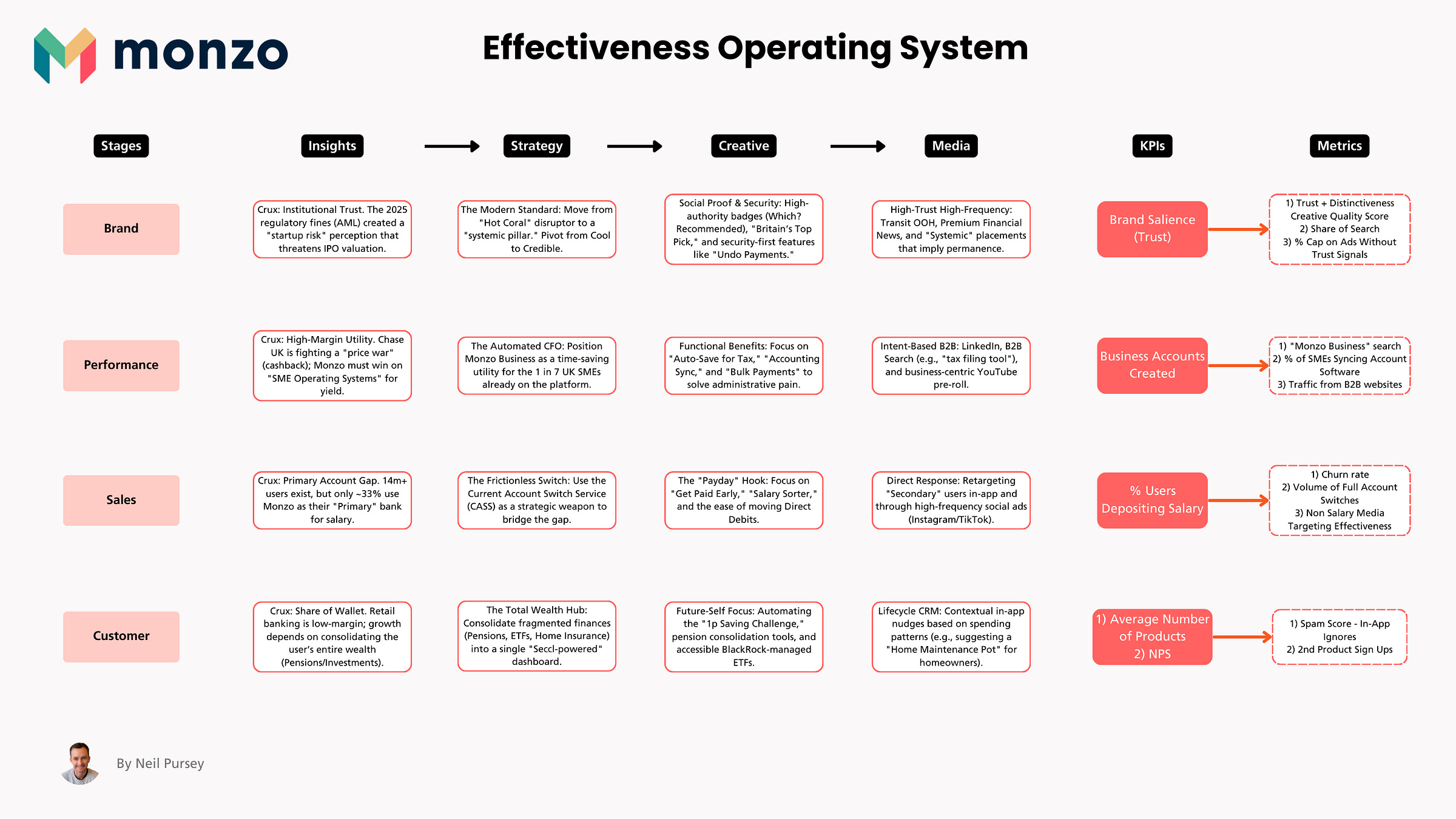
1. Brand: Institutional Legitimacy
- The Strategy: Signaling security through third-party authority.
- Success KPI: Trust Gap (indexed against incumbents like HSBC and Barclays3).
- Counter-Metric (The Fluff Limit): A cap on “lifestyle” creative. If an execution lacks an authority badge (Which?, Trustpilot, etc.), it is excluded from the media mix.
- Metrics: Trust + Distinctiveness Score; Share of Search; % Trust Signaled Creative; Reach.
2. Performance: High-Margin Utility
- The Strategy: Positioning as the “Operating System” for SMEs by solving tax and admin friction.
- Success KPI: New business account acquisition.
- Counter-Metric (The Retail Trap): A spend penalty for agencies hitting volume targets via low-value retail segments. 60% of spend is locked into B2B-intent channels.
- Metrics: “Monzo Business” Search Volume; % SME Software Sync; B2B Referral Traffic.
3. Sales: The Frictionless Switch
- The Strategy: Utilising “Get Paid Early” as the mechanical hook to trigger a full Current Account Switch Service (CASS) migration.
- Success KPI: Percentage of users depositing their primary salary.
- Counter-Metric: Churn-adjusted growth.
- Metrics: CASS Volume; Non-Salary Media Targeting Effectiveness; Churn Rate.
4. Customer: The Total Wealth Hub
- The Strategy: Transitioning from a transactional tool to a comprehensive wealth ecosystem (Pensions, ISAs, Investments).
- Success KPI: Product density (Average revenue-generating products per user).
- Counter-Metric (The Spam Score): The ratio of ignored or muted in-app prompts. If users disengage with cross-selling, the strategy is failing.
- Metrics: 2nd Product Sign-Ups; Net Promoter Score (NPS).
The Marketing Lead as Governor
As Monzo approaches Q2 2026, the leadership’s role is to focus on governance within the system. The objective is to maintain distinctiveness while prioritising the business requirements of a post-IPO environment.
Entropy suggests a viral brand campaign; strategy requires closing the trust gap. Entropy suggests hitting growth targets through cheap retail acquisition; strategy requires the recruitment of profitable SMEs.
Strategy is the discipline of resource allocation. Saying “No” to the low-friction path to ensure the organisation has the capacity to solve for Trust, Utility, and Salary Deposits. Everything else becomes noise.