Have you ever asked yourself, “How do I use audience data to improve brand at a location level?”
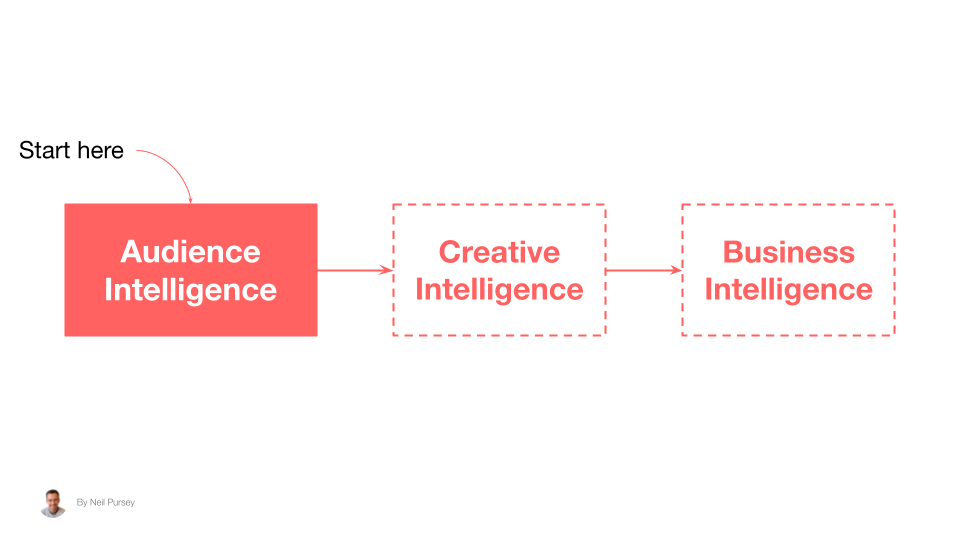
Your journey towards business intelligence starts with audience
To get started, you don’t need an expensive tech stack to find the answer. When digging into the details of most foundational martech stacks—Google Search Console (GSC), GA4, Google Ads, and Meta— you start to realise that you are sitting on a goldmine of regional intent, cultural nuance, and demand signals.
To improve a brand at a location level, you have to separate the strategy and diagnosis of why locations differ from how you execute the creative and media.
Here is how you can stitch your four data sources together to diagnose local market dynamics and build regional brand salience.
1. The strategy starts with diagnosing location-level dynamics
Before changing any ad or writing copy, use your data to categorise your locations. Not every location needs the same brand treatment. You generally have three types of regional markets:
- The Strongholds: High brand salience, high local intent, steady traffic.
- The Under-Indexed: High category demand in the area, but your brand isn’t mentally nor physically available.
- The Outliers: Unique local needs or search behaviours that don’t match your national messaging.
2. Using your data to extract the local signals
Here is exactly how to pull local brand insights from each platform:
Google Search Console (GSC) — The Pure Intent Gauge
GSC is your best indicator of unprompted local interest. While GSC doesn’t break data down by city natively in the performance report, the phrasing of queries reveals geographic intent.
- The Insight: Look for localised long-tail terms (e.g., “service/product + [neighbourhood/city name]”).
- The Brand Fix: If people are searching for your category in a specific city but your brand name isn’t attached to those local queries, you have a local prominence issue. You need to build regional authority.
GA4 — Do a regionalised engagement audit
GA4 allows you to look at user behaviour filtered by Tech > Geo details (Country, Region, City).
- The Insight: Compare Engagement Rate and Average Engagement Time across different cities. If City A has a 70% engagement rate but City B drops to 40%, your national brand message is failing to resonate culturally or contextually in City B.
- The Brand Fix: Audit the landing pages that traffic from City B lands on. Do they feel anonymous, or do they reference local relevance?
Google Ads — Analyse the auction insight & Share of Search
Google Ads gives you the most precise geographic breakdown through location reports and user location views.
- The Insight: Look at your Auction Insights filtered by geographic targets. Who is winning the impression share in specific territories? If a local competitor is eating your lunch in a specific region, your national brand baseline isn’t strong enough there.
- The Brand Fix: Track Share of Search at a regional level by monitoring the impression volume of your branded keywords across different location targets over time. It acts as a predictive proxy for regional market share.
Meta Ads — Understand the cultural & behavioral pulse
Meta doesn’t show you what people are searching for like Google does but it does show you who they are and what they care about based on localised post-engagement.
- The Insight: Run small, localised engagement or reach tests. Look at the comments, share rates, and creative break-downs by region.
- The Brand Fix: Different locations have different cultural triggers. Meta data tells you whether a region responds better to community-focused messaging, functional product proofs, or local heritage.
3. Move from analysis to action
Once the data diagnoses the problem, you use media and creative to fix it.
Meta Ads
Drop wide location targeting. Run micro-radius geo-fenced campaigns (1–5km around key areas) using Dynamic Creative Optimisation (DCO). Swap out ad backgrounds to feature local landmarks, street names, or regional terminology so the brand feels native, not corporate.
Google Ads
Implement aggressive Location Bid Adjustments. In areas where your brand Share of Search is low but category intent is high, bid up on non-branded category terms paired with localised ad copy (e.g., “Proudly serving the [Area] community”).
SEO / GSC
Build hyper-local landing pages. Include structured data (Schema markup), local operational FAQs (e.g., parking availability), and embed native customer reviews from residents of that specific area to build immediate trust.
The Golden Rule of Local Branding: Proximity is power. When a national brand acts like a local neighbor by tailoring its creative to regional insights, consumer trust and purchase intent scale dramatically.
Disclaimer: A Note on Operational FitBefore you dive in: This framework is not a one-size-fits-all solution. For global enterprises with rigid, centralised control, or hyper-niche brands with a completely uniform national buyer profile, decentralising creative execution to this degree may introduce unnecessary complexity.
However, for businesses positioned to scale regionally, this approach bridges a critical strategic gap. It is a blueprint for progressive teams looking to interlink brand and performance by advancing their audience intelligence capability, turning local data insights into a distinct competitive advantage.
This framework doesn’t work if a brand’s value proposition is fundamentally detached from physical geography or local context. For certain business models, forcing a regional lens adds immense operational friction without any strategic payoff.
This approach would not apply to four distinct types of brands:
1. Pure B2B Enterprise SaaS (e.g., Salesforce, Slack, Atlassian)
For a software-as-a-service (SaaS) platform, the audience’s pain point is functional, workflow-driven, and entirely geography-agnostic.
- Why it fails: A Chief Information Officer in Edinburgh is dealing with the exact same data silo and security compliance issues as a CIO in London. Slicing GA4 or Google Ads data by location might show minor variations in volume, but changing the creative execution to sound Scottish or London-centric doesn’t move the needle on trust or utility. The audience mindsets are segmented by industry vertical or company scale, not postcode.
2. High-Regulatory Global Corporate Brands (e.g., Pfizer, Stripe, Goldman Sachs)
In heavily regulated industries like pharmaceuticals, fintech, or global institutional finance, compliance and extreme risk mitigation dictate the marketing strategy.
- Why it fails: These brands rely on strict, centralised templates where legal text, disclosures, and precise brand language are tightly controlled. The risk of letting a regional media team or dynamic ad platform tweak creative assets based on localised Meta comments is a compliance nightmare. For a brand like Pfizer, an unvetted asset circulating in a micro-radius campaign could trigger massive regulatory penalties. Consistency and absolute control override local agility every day of the week.
3. Identity-Driven Global Luxury Brands (e.g., Rolex, Chanel, Apple)
Luxury brands do not adapt to local communities; they expect local communities to look up to them. They build equity through uncompromising, top-down uniformity and an aura of exclusivity.
- Why it fails: Apple relies on an unmistakable, minimalist aesthetic that looks identical whether you are on their website, walking into a store in Tokyo, or seeing an ad in New York. If Apple started using Dynamic Creative Optimisation (DCO) to swap out ad backgrounds to feature local suburban landmarks or regional slang, it would instantly cheapen the premium positioning. The brand value comes from its detachment from ordinary local nuance.
4. Hyper-Niche D2C Monoproducts (e.g., Ridge Wallet, specialised laboratory equipment)
When a brand sells one highly specific item directly to a thin slice of the population globally, their audience is a psychological monolith.
- Why it fails: If you sell specialised laboratory spectrometers, your audience is lab managers. Their geographic location is irrelevant; their professional qualification is everything. Attempting to build regional audience intelligence capabilities here is an expensive misallocation of resources. The channel strategy is entirely driven by where that specific niche aggregates (like LinkedIn or academic search terms), and the messaging remains 100% uniform.
The Litmus Test: If the product doesn’t change physically, operationally, or culturally based on where the buyer is standing when they buy it, do not build a localised brand capability. Keep your strategy centralised, focus on global audience mindsets, and protect your creative efficiency.
BUT…
If a brand’s proposition changes physically, operationally, or culturally based on where a buyer is standing, this framework is a perfect fit. It is built for businesses where location directly impacts the purchase decision or consumer experience.
The approach works beautifully for four distinct types of brands:
1. Multi-Location Retail & QSRs (e.g., McDonald’s, Starbucks, H&M)
Quick Service Restaurants (QSRs) and physical retailers live or die by regional nuance.
- Why it fits: While the parent brand provides global guidelines, consumer behaviour is deeply local. McDonald’s or Starbucks use local intelligence to identify which regions demand specific menu items (like Matcha in Japan or regional flavour preferences) and adapt their physical store layout and media strategy accordingly.
- The Data Connection: They use Meta geo-fencing and localised Google search intent to drive physical foot traffic within a strict 1–5km radius of a specific branch.
2. Marketplace & Aggregator Platforms (e.g., Airbnb, Uber, Property Portals)
These platforms are digital, but their utility is entirely physical. They connect local supply with local demand.
- Why it fits: An Airbnb user looking for a beach villa in Cape Town has a completely different mindset, search journey, and intent profile to someone booking a business apartment in London.
- The Data Connection: By tracking local search trends via GSC and regional booking conversions in GA4, these platforms can see precisely where supply is lagging behind intent. They can then deploy hyper-localised Meta ads to recruit new hosts or showcase specific types of properties native to that area.
3. Direct-to-Consumer Brands with Regional Logistics (e.g., Craft Breweries, Apparel, Grocers)
When shipping costs, stock availability, or climate conditions vary across regions, a uniform national marketing message fails.
- Why it fits: A clothing brand shouldn’t push heavy winter coats to a region experiencing an unseasonably warm spell, nor should a beverage brand advertise a product that is out of stock in local distribution centers.
- The Data Connection: Layering real-time weather or stock data over localised Google Ads and Meta campaigns ensures the creative execution aligns perfectly with what the local audience is experiencing right outside their window.
4. Fragmented Consumer Services (e.g., Banking, Auto Repair, Pest Control)
For services where trust and proximity are the primary buying criteria, consumers look for local validation.
- Why it fits: A regional credit union or a home services business (like Western Pest Services) cannot rely on generic national messaging because consumers want to know, “Can you help me in my specific neighbourhood right now?”
- The Data Connection: They monitor localised long-tail keywords in GSC (e.g., “[service] + [neighborhood]”) and use Google Ads Location Bid Adjustments to aggressively capture that high-intent demand before local competitors can claim it.
The Operational Blueprint: For these brands, audience intelligence is how they protect their media effectiveness. It allows them to act like a nimble, trusted neighbour on the ground while still leveraging the operational scale of a major brand.