Through my work with senior leadership, managing and interacting with teams, I inevitably come back to two fundamental concepts that are consistently misunderstood by performance marketers:
Distinctiveness and Brand Salience.
In those annual marketing reviews, we often talk about improving marketing performance, but we struggle to convert this desire into practical steps towards effectiveness. Instead, we fall back on old habits by month 4 of trying to figure this thing out called “effectiveness”. So every year, just like the year before, we’re clutching at straws, with that media-optimisation mindset.
It’s a mistake marketers make… We rush in and try to fix performance without acknowledging the fundamental lack of distinctiveness in our creative assets and messaging.
These two teams for the most part, operate in silos. Knowledge sharing then becomes non-existent.
True distinctiveness isn’t built overnight, and neither is the understanding of it. Depending on the team’s maturity, market size, and budgets, it can take months, if not years, to reach true distinctiveness in the market.
For clarity, distinctiveness is a leading metric for effectiveness. Distinctiveness first, then effectiveness. In that order.
But like all good things, it requires balance. Distinctiveness isn’t an all-or-nothing game. It is built on marginal gains over time that yield massive, compounded results.
You just have to start somewhere.
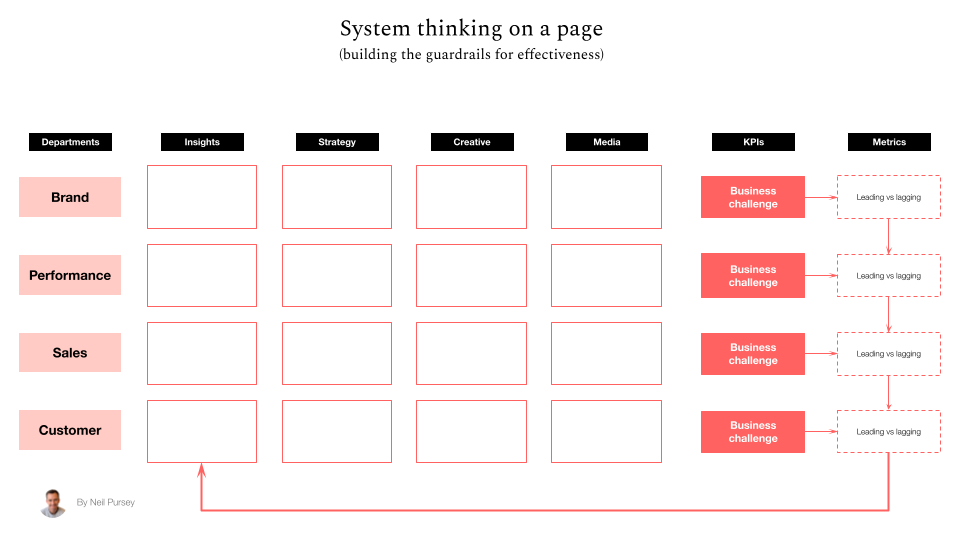
The effectiveness system on a page framework that I use (or eOS, Effectiveness Operating System) lays out the operational sequence required to build an enduring system, one that threads distinctiveness through every column so that brand salience can actually be achieved.
This subtle nuance in approach activates knowledge sharing, an important ingredient for an effectiveness outcome.
When you operate with the following mindset, effectiveness becomes a natural byproduct.
- Business challenge (and that doesn’t mean leads or sales, it’s deeper than that)
- Distinctiveness
- Brand salience
Phase 1: Establish the Understanding of Distinctiveness (Months 1–3)
If your marketing teams are running in opposite directions, your brand assets will be compromised. Establishing distinctiveness requires breaking down internal silos and aligning the entire marketing department around a shared understanding of the core business challenge. Only then can you build a cohesive, long-term vision to improve the brand’s distinctiveness in the market.
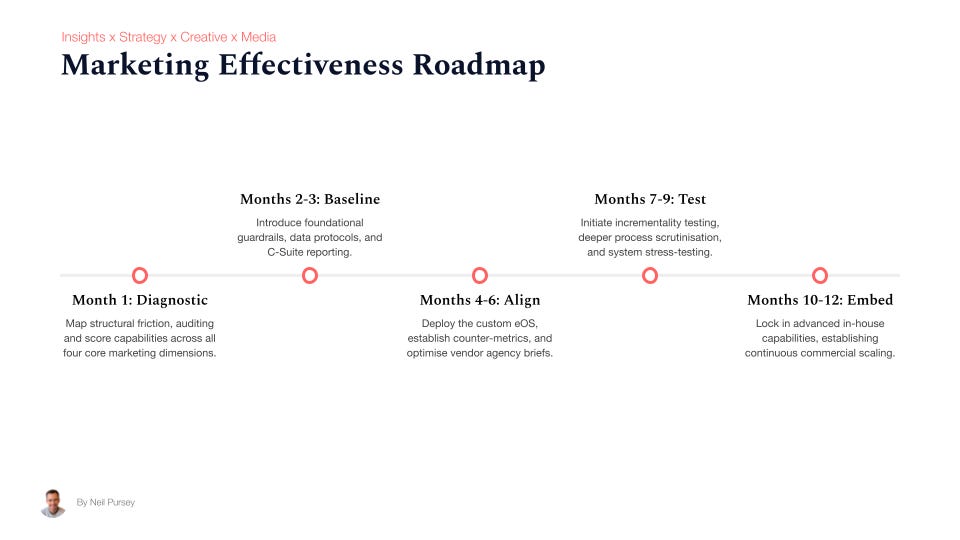
This phase is about setting that clean, unvarnished baseline.
- Month 1. Diagnostic: We start by assessing maturity across all four departments: Brand, Performance, Sales, and Customer; and scoring them against the four core marketing dimensions: Insights, Strategy, Creative, and Media.
By mapping this matrix, we expose exactly where distinctiveness is dropping off. Showing the C-suite data they understand but have never seen before immediately wins attention and credibility.
- Months 2–3. Baseline: We scrutinise the performance marketing strategy and get crystal clear on the core business challenge. We introduce foundational guardrails, data protocols, and stripped-down reporting for the C-suite.
When the CFO, CEO, and CMO look at the same data and can agree on the baseline metrics, subjective second-guessing stops. You have created a single, distinct source of truth.
We also install a weekly ideation session with the performance team: the IdeationRoom. I can’t begin to tell you how important this is!
The outcome is building the habit of showing up every week to discuss new ideas.
Phase 2: Drive Brand Salience (Months 4–12)
Moving from a clean baseline to commercial scaling is an endurance effort that is worth it. This is where we build brand salience, ensuring that the strategic value of marketing remains top-of-mind for the C-suite, while the work itself begins to capture mental share in the market.
To execute this, we introduce a pod structure designed to enable coherent judgment and decision-making.
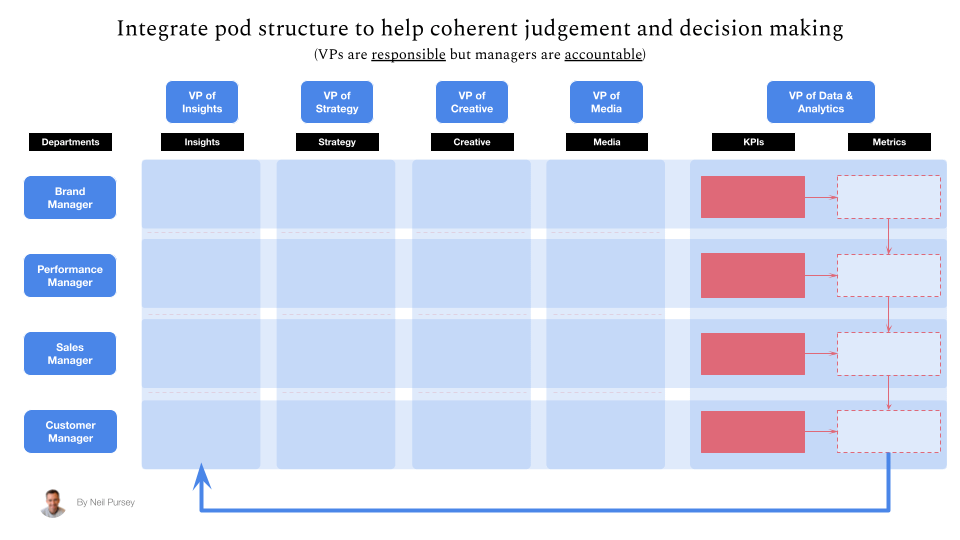
In a large enterprise or international brand, this means dedicated roles where VPs (Insights, Strategy, Creative, Media, Data & Analytics) are responsible for their strategic pillars, while department managers are accountable for execution.
However, this framework is highly adaptable. For a medium-sized national brand, these roles will naturally amalgamate:
- The CMO can step in to play the dual role of VP of Insights and VP of Strategy.
- Your Creative Agency takes on the role of VP of Creative or a dual role with the CMO / Brand Manager.
- Your Media Agency steps in as the VP of Media or a dual role with the Performance Manager.
- The CTO can comfortably step into the role of VP/Head of Data & Analytics.
While the team structure scales based on the size and maturity of the brand, the underlying effectiveness principles remain exactly the same.
Alignment is messy. Embrace the friction, stay calm, and lean on your Phase 1 principles.
- Months 4–6: Align: This is where we deploy the custom Effectiveness Operating System (eOS), establish counter-metrics, and improve vendor agency briefs.
This phase is where we integrate brand and performance, the foundational job of the eOS. We thread distinctiveness deeply through the Creative column, because its ultimate effectiveness is felt and amplified in Media. It takes patience from leadership because we are rewiring how these two disciplines work together, rather than chasing short-term, superficial spikes.
- Months 7–9: Test: Armed with hypotheses from the IdeationRoom and better campaign structures, we initiate incrementality testing.
We keep platform attribution as a signal, but we test deeper to prove what genuinely drives incremental value and brand salience. It requires discipline to let these tests run their course properly.
- Months 10–12: Embed: Once we successfully systemise a pilot workflow, we lock in advanced in-house capabilities.
Crucially, we complete the system feedback loop: lagging and leading metrics from the Data & Analytics team are fed directly back into Insights. We are no longer just reacting to media algorithms; we are feeding market realities back into our strategic engine to continuously refine our distinctiveness.
The takeaway is simple.
You cannot scale brand salience with an optimisation or efficiency mindset. Performance teams cannot rescue non-distinct creative with clever targeting.
You have to start by assessing your maturity across the entire matrix of your marketing, product, sales and customer departments. By focusing on marginal gains across Insights, Strategy, Creative, and Media, and feeding your performance metrics back into your insights, you build an enduring system that actually performs.