With your 2026 KPIs locked in or close to being locked in. This decision will do one of two things: it will either set marketing’s influence up for real, sustainable growth, or it will trap marketing in a “Distraction Zone” for another twelve months.
Charlie Munger once said, “Show me the incentive and I’ll show you the outcome.”
For CMOs of national brands struggling to maintain market share against economic headwinds, this has never been truer. If you incentivise your team with the wrong metrics, you will get the wrong outcomes.
The world’s biggest brands know this. Their marketing teams aren’t only chasing 2026 results; in parallel they are also building for 2028.
However, many medium-sized businesses are currently being held back by what Les Binet calls “small brand thinking.” They are distracted by vanity, opting for the “easy way out” because the pressure from the C-Suite is real. To find the right balance, you have to understand where your metrics actually live.
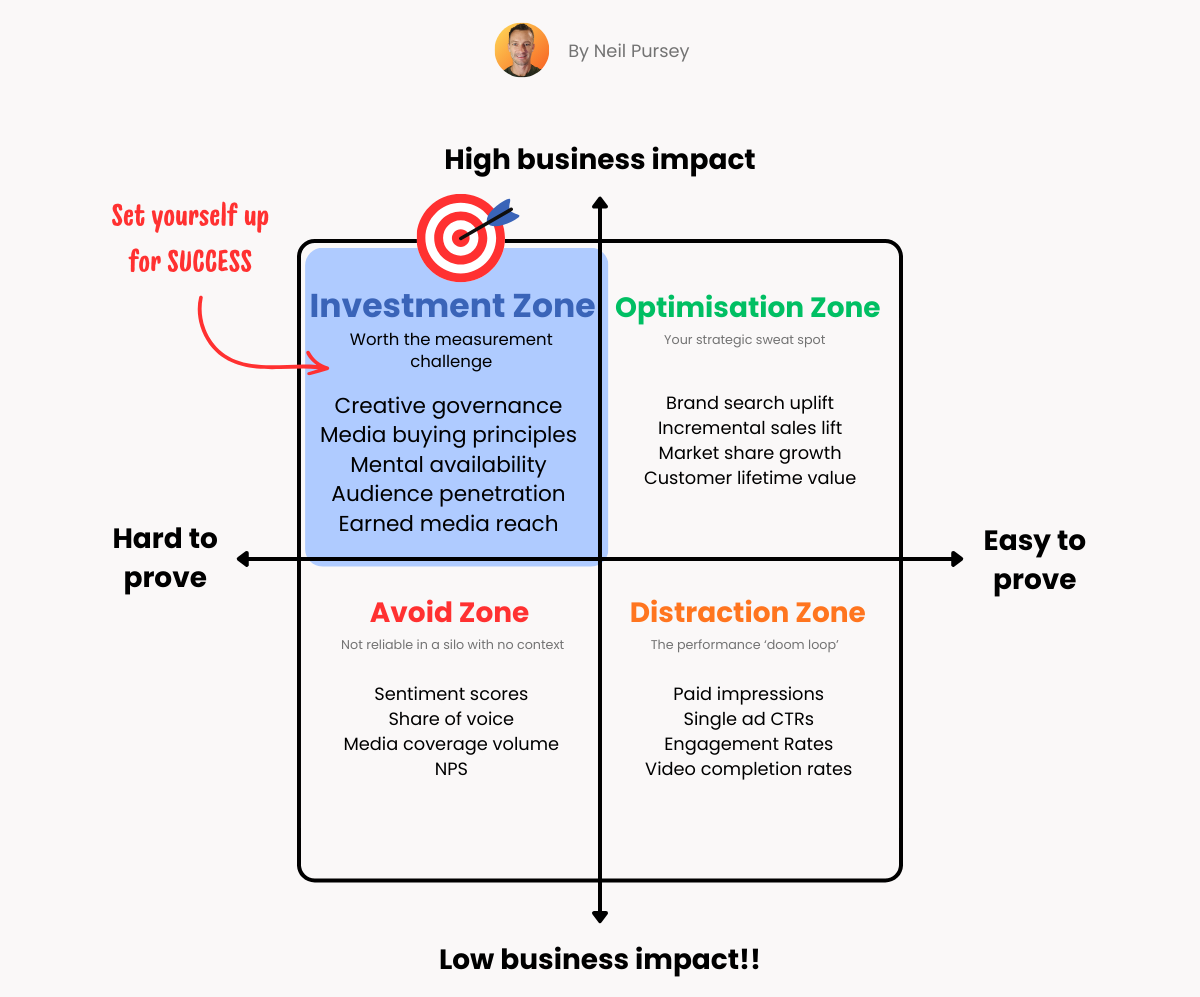
The Distraction Zone
Low Impact, Easy to Prove
Many marketing teams spend 80% of their time here because it feels safe. These are your platform metrics: Impressions, CTRs, CPCs, and Engagement rates. They are easy to report weekly, and platforms are designed to optimise for them.
The problem? They rarely connect to actual business outcomes. If you are trapped here, you are optimising for the platform, not the business.
The Avoid Zone
Low Impact, Hard to Prove
These are metrics that waste both time and budget. Things like sentiment scores without business links, NPS without revenue correlation, or “black box” modeled attribution. You can’t prove they matter, and in most cases, they don’t.
The Investment Zone
High Impact, Hard to Prove
This is where strategic CMOs separate themselves from tactical ones. This is your brand infrastructure. It requires a commitment to:
- Creative Governance: Ensuring excellence across both brand and performance.
- Media Principles: Establishing 60/40 splits and correct channel mixes.
- Mental Availability: Tracking brand salience and category entry points.
These take time to measure and infrastructure to build. But if you don’t address this “hard way” upfront, you will never reach the next level.
The Optimisation Zone
High Impact, Easy to Prove
This is the “strategic sweat spot” where you prove to your CFO that brand investment creates the conditions for performance to thrive. When you get your Investment Zone right, you start seeing the results here: brand search uplift, incremental sales lift, and market share growth.
Focus on the Inputs, Not Just the Outcomes
The mistake many companies make is rushing toward the sophisticated measurement of the Optimization Zone (MMM, Incrementality) before they have the governance of the Investment Zone in place.
Your MMM and incrementality tests are basically guesses at best without the governance of the top-left quadrant.
If you want to protect growth in 2026, stop focusing solely on outcomes and start focusing on the inputs. Your KPIs should be about the implementation of the framework:
- What is our creative excellence score?
- Are we adhering to our media buying principles?
- How many effective tests are we running this quarter?
There will always be demand for the easy way out. There will always be pressure to stay in the Distraction Zone. Don’t be that team. Choose the hard way upfront, and the rest becomes easy downstream.